

A complete set can bring more than the sum of its parts, but not always. In coin set valuation vs individual coins, the right choice depends on condition, completeness, demand, and the market for that exact series. A set in uniform grade can sell for a premium; a single standout coin can still be worth more than the rest combined.
The Set vs Individual Coin Valuation Dilemma
The real question is whether the market rewards completeness more than it rewards a high-grade outlier. In many collections, coin set valuation vs individual coins comes down to whether buyers want a matched group, a key date, or pure rarity.
A complete set has emotional appeal and often a built-in completion premium. That premium can disappear fast if one coin is out of grade, cleaned, damaged, or missing. Individual coins are often easier to price because the market already has deep data for high-demand dates and top-population grades.
One overlooked advantage of set valuation is buyer psychology: many collectors pay extra to avoid the time cost of hunting matching coins across months or years. That saved effort creates a premium that does not show up in the price guide.
Understanding Coin Set vs Individual Coin Premiums
A coin set premium is the extra value a buyer pays for a matched, complete collection — convenience, visual consistency, and completion status all rolled into one price. That premium shrinks when condition varies across the set, when one coin is damaged, or when the set lacks a scarce key date. PCGS and NGC both factor certified condition and population scarcity into their pricing.
Set premiums are strongest where finish matters. Proof sets, modern commemoratives, and registry-quality runs benefit from uniformity. Mixed-grade accumulations, raw albums with spots, and sets with one or two weak coins tend to trade like parts rather than a whole.
What creates a set premium?
- Matching grade across the entire set
- Strong eye appeal and original surfaces
- Hard-to-complete series with thin supply
- Certified holders from PCGS or NGC
- Demand from registry set collectors
PCGS Set Registry competition can push demand for high-ranking certified sets, but the premium still depends on the series, the grades, and the look of the coins.
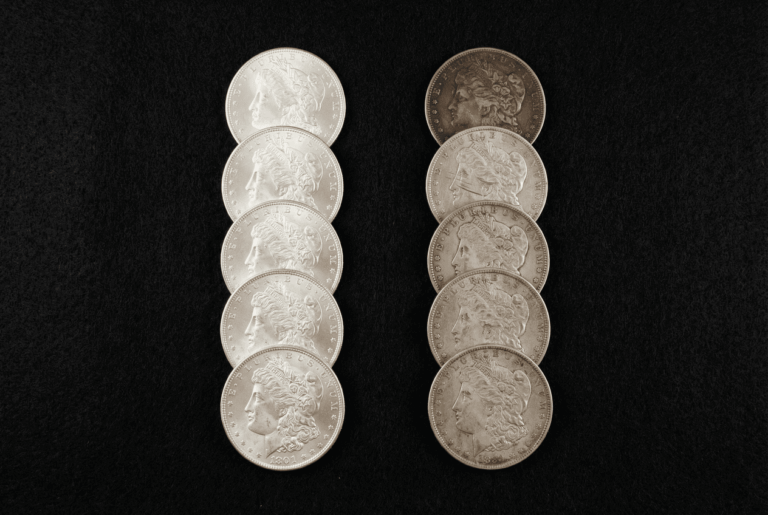
Grade consistency is visible at a glance – and buyers notice immediately.
Key Factors That Affect Complete Set Values
1. Grade consistency
A set with 20 coins in similar condition usually brings more than one with 19 strong coins and one weak link. Buyers notice the mismatch immediately. One low-grade coin can drag down the whole lot because it signals compromise rather than quality.
2. Completeness
A truly complete set reaches collectors who want certainty. Missing a single coin moves a set from “ready to own” to “project piece,” and project buyers expect a discount for the work involved.
3. Original surfaces and toning
Original mint luster, natural toning, and minimal cleaning help a set. Harsh cleaning, scratches, or color mismatch reduce trust and lower what buyers will pay.
4. Series demand
A complete Morgan dollar set attracts a different audience than a modern commemorative run or an international type set. Popular series support deeper bidding and better exit liquidity. Set value rises fastest when the set is hard to replace in a single purchase — a buyer paying for convenience may accept a small grade tradeoff if everything is already matched and certified.
When Individual Coins Are Worth More Than the Set
Individual coins beat set value when one or more pieces are rare, conditionally scarce, or in a market where collectors buy by date and grade rather than by complete run. A single key date can carry the whole valuation — if a low-mintage coin has exceptional eye appeal or a top population grade, it may sell for more on its own than it contributes inside the group.
This happens often with:
- Key dates and semi-key dates
- High-grade certified coins with top-population status
- Coins with major varieties or error attributes
- Rare international issues inside mixed collections
- One-off pieces with exceptional color or toning
Break a set only when the expected sale price of the individual coins clearly exceeds the likely price of the set as a whole, after fees and time costs. If the set is matched and desirable, keep it intact.
Professional Appraisal: Sets vs Individual Evaluation
A proper appraisal starts with the same basics either way: authenticity, grade, rarity, and demand. The difference is that set appraisal also checks harmony across the group — whether the coins belong together in a way the market rewards. A set can include several coins that grade well individually but still lose value because they do not match in color, luster, or eye appeal.
If any coin looks suspicious, use a coin authentication guide or third-party expert before assigning value. Authentication matters as much as grade.
How appraisers price a set
- Identify the strongest and weakest coins.
- Check certification status and third-party grades.
- Compare recent auction results for similar sets.
- Estimate what each coin would fetch separately.
- Apply a completion premium or a bulk discount.
A coin can earn a top grade and still sit in a set that sells below expectation if the rest of the collection looks uneven. NGC’s grading guide makes the same point — market value reflects grade, eye appeal, strike, and surface preservation, all of which change how a coin contributes to set pricing. (NGC, Grading Scale)
Mistakes that cost sellers money
- Cleaning coins before appraisal
- Breaking up a matched set too early
- Overlooking shipping, listing, and auction fees
- Pricing by metal value alone
- Assuming older always means more valuable

Market Timing: When to Sell Sets vs Break Them Apart
Collector demand shifts with series popularity, auction cycles, bullion prices, and registry competition. A complete set usually sells best when demand is broad and buyers want convenience — during active auction seasons or when a series gets fresh attention from a major sale. Individual coins perform better when the market is hunting specific dates or top grades.
Sell the set when:
- The set is matched and attractive
- The series has active collector demand
- Certification supports the whole package
- The time cost of piecing out coins is too high
Break the set when:
- One coin clearly outvalues the rest
- The set has a weak or damaged component
- Auction data shows stronger results for singles
- You can sell to multiple specialized buyers
Tax Implications of Set vs Individual Sales
Breaking a set into individual coins can create more transactions, more records, and a different mix of gains or losses than selling intact. The IRS taxes net capital gains on collectibles like coins at a maximum 28% rate — higher than the long-term rate most taxpayers pay on stocks. (IRS Topic No. 409)
Track your cost basis carefully, especially if coins were inherited, purchased over many years, or upgraded over time. A single set sale is simpler to document, but individual sales may let you spread gains or offset losses differently.
Points to review before selling
- Original purchase records and invoices
- Insurance appraisals and updated valuations
- Whether the coins qualify as long-term holdings
- Whether the sale creates short-term or long-term gain
- State tax treatment where you live
Professional tax advice is worth the cost for inherited or high-value collections.
Digital Tools and Resources for Set Valuation
Digital tools speed up coin collection appraisal, but they do not replace judgment. The best approach is a two-step check: price the set as a unit, then total the likely net sale of each coin after fees. That comparison exposes hidden premium or discount gaps a single price guide misses.
- PCGS Set Registry — matched and certified set comparisons
- NGC grading guides — condition and population context
- Heritage Auctions archives — real sale results and price trends
- CoinWorld — market coverage and trend spotting
- ANA education pages — valuation principles and methodology
When comparing, focus on recent auction results for the exact series, population reports for certified pieces, raw vs certified pricing gaps, and seller fees at each venue.
Case Studies: Real Set vs Individual Valuations
Real-world valuations usually land on one of three outcomes: the set wins, the individual coins win, or the spread is close enough that fees decide it.
Case 1: A matched proof set
A well-preserved proof set with consistent eye appeal almost always sells best intact. Buyers pay for uniformity and presentation. Breaking it apart destroys the feature that made it attractive in the first place.
Case 2: A mixed-grade commemorative run
If a set contains one premium coin and several common pieces, the premium coin may sell better alone. The whole set rarely earns much beyond what that strongest piece brings on its own.
Case 3: A vintage set with one top-pop coin
A registry-worthy coin inside an otherwise average set can shift the math. If the standout is scarce in high grade, piecing out the collection may outperform a single-set sale.
Frequently Asked Questions
What is the fastest way to estimate coin set value?
Start with the strongest individual coin, then add the likely value of the remaining coins using recent auction comps. If the set is certified and matched, add a modest completion premium. If it is mixed-grade or incomplete, test the individual coin route instead.
Does certification matter more for sets or single coins?
It often matters more for sets because collectors want uniformity and trust across the group. A certified set sells faster and with fewer questions. Individual coins can still do well uncertified if they are rare or high grade.
Should I get a professional coin collection appraisal before selling?
Yes, especially if the set includes key dates, proof coins, or multiple certified pieces. An appraisal reveals whether the set has a completion premium or whether specific coins should be priced separately.
How do taxes affect the decision to break up a coin set?
Piece-by-piece sales create more records and can change the timing of your gains. If the collection is high value, inherited, or held for a long time, get tax advice before splitting it up.
Key Takeaways
- Price the set and the individual coins separately before listing anything.
- Keep matched, high-eye-appeal sets intact unless one coin clearly dominates the value.
- Use recent auction comps and certification data — not retail wish pricing.
- Factor in taxes, fees, and selling costs before deciding to break a set.
Should You Sell a Coin Set or Break It Apart?
A complete set is not automatically worth more than the coins inside it. The better path in coin set valuation vs individual coins depends on how closely the pieces match, how strong the series demand is, and whether one coin stands out enough to justify separation. Price both ways, compare the net result after fees and taxes, and let the numbers decide. If they are close, keep the set intact.